

Single Stage Paint Correction San Diego: Is One Step Enough for Your Car?
TL;DR
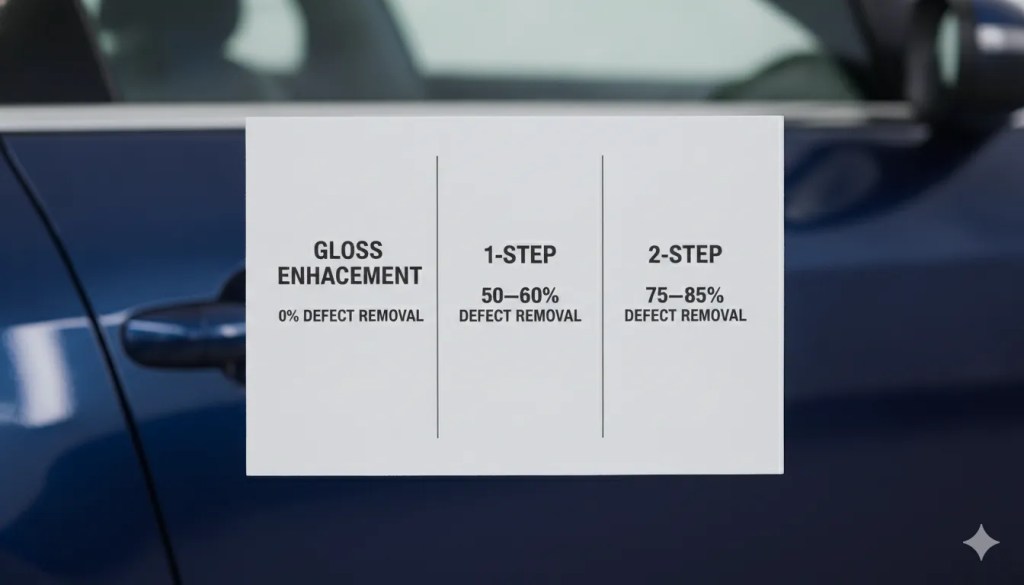
Single stage paint correction is a one-pass machine polish that removes 50–60% of light surface defects — swirl marks, buffer haze, mild oxidation, and minor water spot etching. It costs $550–$650 at Dennis Auto Details depending on vehicle size. It’s the right choice for cars in good but not perfect condition. For paint with heavy scratches or significant oxidation, a 2-step correction delivers better results. The entire service is performed mobile — right at your home or office in San Diego.
What Is Single Stage Paint Correction?
Single stage paint correction — also called 1-step paint correction or one-step correction — is a machine polishing service that uses a single compound-and-polish pass to remove surface defects from your car’s clear coat.
In one controlled polishing stage, a professional technician applies a compound matched to your paint hardness and defect severity using a dual-action or rotary machine polisher. That single pass removes 50–60% of visible surface defects and restores clarity, depth, and gloss to paint that has gone dull from everyday wear.
This is not a wax or gloss spray. It is abrasive correction — the clear coat surface is physically leveled to remove the defects within it. The results are permanent, not temporary.
San Diego’s environment makes single stage correction a high-value service for vehicles that are regularly maintained but still show the effects of UV exposure, coastal salt air, and the micro-scratching from poor wash technique over time. A car that looks fine from ten feet away can have visible swirl marks under direct sunlight — and a 1-step correction fixes that.
⭐ Google Review: “I’m so happy with my paint correction service! Dennis was extremely knowledgeable and walked me through exactly what he was doing. My car looks incredible. 10/10 would recommend.” — Verified Google Review
What Single Stage Correction Fixes
The Dennis Auto Details 1-step paint correction service addresses these specific paint conditions:
Light Swirl Marks
The most common paint defect on San Diego vehicles. Swirl marks appear as circular haze patterns in the clear coat, usually caused by automated car washes, dirty microfiber towels, or improper hand-wash technique. A single polishing stage removes them completely.
Buffer Haze and Hologramming
If your car was previously polished by someone using an incorrect machine speed, pressure, or product, you may have machine-induced haze visible in the clear coat. A 1-step correction with the right compound and pad removes this.
Mild Oxidation
San Diego’s UV index — regularly reaching 8–11 — causes oxidation faster than in most U.S. cities. Mild oxidation shows as a slight dulling or chalky tone to the paint. Single stage correction restores the surface clarity in these early stages. Severe or advanced oxidation requires the cutting compound step of a 2-step process.
Minor Water Spot Etching
Hard water spots from irrigation systems, condensation, and unfiltered tap water bond mineral deposits to the clear coat. If the etching is light and surface-level, a 1-step correction removes it. Deeper etching may require wet sanding before polishing.
Overall Paint Dullness
Sometimes paint just loses its depth and pop over time without any specific visible defect. A single-stage polish enhances gloss, restores clarity, and makes paint look dramatically better even when no individual defect is obviously present.
What Single Stage Correction Does Not Fix
Setting honest expectations matters. A 1-step correction is not the right tool for everything.
Heavy Scratches
Scratches that go deeper into the clear coat — ones your fingernail catches when you drag it across the surface — need the cutting compound stage of a 2-step process. A single polish pass does not have the abrasive power to remove deep clear coat defects without risking uneven correction.
Significant Oxidation or Fading
Advanced oxidation where the clear coat is visibly chalky or the color looks flat in multiple areas requires compounding before polishing. The 2-step paint correction service — which uses a cutting compound first, followed by a refining polish — is built for this level of restoration.
Deep Water Spot Etching
Water spots that have aggressively etched into the clear coat over months or years may be below what a single polish stage can safely reach. These often require wet sanding to level the surface before polishing.
Scratches Through the Base Coat
Any scratch that has penetrated through the clear coat into the color layer or below cannot be corrected by polishing. Touch-up paint and possible body shop work is the correct approach for these defects.
The honest recommendation: if your paint is in good condition with light, everyday wear, 1-step correction is the right call. If you look at your car under direct sunlight and see heavy swirling, significant dullness, or scratches you can feel with your fingernail, step up to the 2-step service. It costs slightly more but delivers dramatically better results for paint in that condition.
According to Detailed Image’s professional detailing guide, most daily drivers benefit from a one-step service, especially on lighter-colored vehicles. Darker colors — particularly black — often benefit from a two-step approach because they show residual defects more readily.
The Single Stage Correction Process: What Dennis Does
Every paint correction appointment at Dennis Auto Details follows this exact sequence. You know what to expect before the technician arrives.
Step 1: Paint Assessment
The technician inspects your paint under specialized correction lighting and measures clear coat thickness with a paint gauge. This determines whether 1-step or 2-step correction is appropriate and ensures safe polishing without over-thinning the clear coat.
Step 2: 4-Step Decontamination Wash
Before any polishing begins, the vehicle goes through a complete decontamination process:
- Foam pre-wash to remove loose surface contamination
- Hand wash with pH-balanced shampoo
- Clay bar treatment to remove bonded contaminants (iron particles, tar, industrial fallout)
- Iron and fallout decontamination spray
- Deep wheel and tire cleaning, including barrels and wheel wells
- Hand dry with soft microfiber towels and compressed air blowout
Polishing over surface contamination causes new scratches. This step is not optional.
Step 3: Machine Polish
Using a RUPES dual-action polisher, the technician works panel by panel with a compound and pad combination selected for your paint type and defect level. Consistent, controlled passes remove the clear coat defects and restore the surface.
Step 4: IPA Wipe-Down
After polishing, the surface is wiped down with an isopropyl alcohol solution to remove all polishing oils. This is a required step before any ceramic coating or sealant application — polishing oils left behind prevent proper bonding.
Step 5: Final Inspection
The technician reviews the vehicle under correction lighting to confirm defect removal and even results across all panels.
Optional Step 6: Ceramic Coating or Sealant
Correction results last 1–3 years with standard care. A ceramic coating applied after correction extends protection to 2–9 years and prevents new swirl marks, water spots, and UV damage from forming on the corrected surface.
Single Stage Paint Correction Cost in San Diego
Dennis Auto Details prices the 1-step correction at $550–$650 depending on vehicle size. Here’s the breakdown:
| Vehicle Type | 1-Step Price |
|---|---|
| Coupe | $550 |
| Sedan | ~$575 |
| 2-Row SUV | ~$600 |
| Truck | ~$625 |
| 3-Row SUV / Minivan | $650 |
These prices include the full 4-step decontamination process, machine polishing, IPA wipe-down, and final inspection. No prep fees added separately.
For comparison, the 2-step correction — which adds the cutting compound stage — runs $650–$750 for the same vehicle sizes. If your paint has significant defects that a 1-step won’t fully address, the upgrade cost is modest and the results are substantially better.
The service is completely mobile. Dennis Auto Details comes to your home, office, or any location across San Diego County — Carmel Valley, La Jolla, Del Mar, Carlsbad, Escondido, Chula Vista, and 40+ other neighborhoods. There is no shop visit, no drop-off, and no waiting around.
Is Single Stage Correction Enough Before Ceramic Coating?

This is the question most customers ask when they’re planning a ceramic coating application.
The answer is: it depends on your paint’s current condition.
For paint in genuinely good condition — light swirling, minor dullness, no deep scratches — a 1-step correction creates the clean, defect-free surface that a ceramic coating needs to bond properly and perform at its best. In this scenario, 1-step is the right prep and you don’t need to spend more.
For paint with moderate to heavy defects — visible scratches, significant oxidation, swirling visible in standard daylight — a 2-step correction is required before coating. Here’s why this matters: once a ceramic coating is applied and cures, it locks in the surface beneath it permanently. Any defects present when the coating goes on remain visible under the coating for its full lifespan of 2–9 years. There’s no going back without removing the coating.
At Dennis Auto Details, every ceramic coating package includes a paint assessment. The technician will tell you honestly which correction level your paint actually needs — not the most expensive option, just the right one.
According to Chemical Guys, applying a wax or ceramic coating over uncorrected paint locks every defect underneath. The protection looks glossy, but the imperfections remain visible in direct sunlight. Correcting first gives you a genuinely flat, clean surface that holds protection better and reflects light more evenly.
For luxury car detailing clients with European vehicles, exotic finishes, or soft paints, the recommendation is typically 2-step before any coating — softer paints show residual defects more readily, and the investment in the vehicle justifies the more thorough correction.
Ready to Book? Here’s How to Schedule
Call or text: 858-298-7259
Book online: dennisautodetails.fieldd.co
Contact form: dennisautodetails.com/contact-us
If you’re not sure whether your paint needs a 1-step or 2-step correction, call or text with a photo of your paint under direct sunlight. The team can help you identify which level is appropriate before you book.
Key Takeaways
- Single stage correction removes 50–60% of light surface defects in one polishing pass
- Best for: vehicles with light swirl marks, mild haze, minor water spots, or slight oxidation
- Not suitable for: heavy scratches, deep oxidation, or paint needing more than moderate correction
- Cost in San Diego: $550–$650 depending on vehicle size
- For paint in good condition, single stage correction is sufficient prep before ceramic coating
- Dennis Auto Details performs this fully mobile across 40+ San Diego neighborhoods
Frequently Asked Questions
What is single stage paint correction?
Single stage paint correction is a one-pass machine polishing service that removes 50–60% of light surface defects from the clear coat. It uses a single compound and polish combination to eliminate swirl marks, light scratches, mild oxidation, and surface haze.
How much does 1-step paint correction cost in San Diego?
Dennis Auto Details prices the service at $550–$650 depending on vehicle size. The price includes a full 4-step decontamination process and machine polishing. No hidden prep fees.
How do I know if I need 1-step or 2-step correction?
Use the fingernail test. If your fingernail glides over scratches without catching, a 1-step correction is likely sufficient. If you can feel a groove or if paint shows heavy oxidation visible in normal daylight, opt for the 2-step service which includes a cutting compound stage.
How long does single stage correction last?
With standard care, correction results last 1–3 years. A ceramic coating applied after the correction extends protection to 2–9 years and prevents new surface damage from forming.
Is 1-step correction enough before ceramic coating?
For paint in good condition with light defects, yes. For paint with moderate to heavy defects, a 2-step correction is required. Any defects in the paint when the ceramic coating is applied will be permanently locked in under the coating.
Does single stage correction work on dark-colored cars?
Yes, but darker colors — especially black and deep blue — show surface defects more readily than lighter colors. If your dark-colored vehicle has visible swirling, you may achieve better results with a 2-step correction that includes a cutting compound to remove deeper marks before the finishing polish.