

Ceramic Coating La Jolla and Del Mar: The Smart Way to Protect a Luxury Vehicle
TL;DR
- La Jolla and Del Mar vehicles face relentless salt air, UV damage, and marine layer exposure that strips paint faster than almost anywhere else in San Diego County.
- Ceramic coating creates a semi-permanent protective barrier that blocks UV rays, repels salt and water, and resists chemical contaminants.
- Graphene and 9-year ceramic coatings are the best investment for high-value vehicles — one application protects for nearly a decade.
- Dennis Auto Details comes directly to your home, condo, or gated community in La Jolla, Del Mar, and Rancho Santa Fe — no shop trip required.
You drive a $90,000 BMW. You live 400 feet from the Pacific in La Jolla. Every morning, salt air settles on your paint. Every afternoon, UV index 10 does its work on your clear coat. Every week, bird droppings and tree debris land on that pristine hood.
Across San Diego, a professional ceramic coating typically costs $600 to $2,000+. A full paint correction and respray can run $5,000 or more. The math is obvious — and yet most La Jolla and Del Mar vehicle owners skip the coating until the damage is already done.
This guide covers exactly what ceramic coating does, why graphene coating is the best option for high-value vehicles near the coast, and how Dennis Auto Details delivers shop-quality results at your door.
Why Coastal Vehicles Take the Hardest Hit
Vehicles parked and driven in La Jolla, Del Mar, and Rancho Santa Fe face a combination of environmental threats that inland San Diego drivers simply don’t deal with at the same intensity.
Salt air is the most aggressive. Ocean spray carries sodium chloride particles that settle on your paint and begin breaking down the clear coat at a microscopic level. Vehicles parked within a half mile of the coast accumulate salt deposits even when it hasn’t rained and the car hasn’t moved.
UV exposure in coastal North San Diego runs at UV Index 8 to 11 for most of the year. That sustained radiation oxidizes clear coat, fades paint, and dries out rubber trim. Lighter paint colors like white and silver show yellowing faster. Darker colors like black and navy develop swirl-amplifying hazing within a few years.
Marine layer adds moisture cycling. The June Gloom burns off by afternoon but leaves behind condensation that carries salt and pollutants. That moisture sits on your paint during the night and accelerates chemical reactions.
Bird droppings and tree debris are highly acidic. In summer heat, they etch into clear coat within hours. Vehicles parked under coastal eucalyptus trees or near bird nesting areas in La Jolla take regular hits.
Without a protective barrier, these forces work 24/7 on your paint. A ceramic coating interrupts that process completely.
What Ceramic Coating Does to Stop the Damage
Ceramic coating is a liquid polymer that bonds at the molecular level with your vehicle’s clear coat. Once cured, it forms a rigid, hydrophobic shell that sits between your paint and everything the environment throws at it.

Here is what that shell does for a La Jolla vehicle:
Blocks UV rays. The coating absorbs and deflects UV radiation before it can penetrate the clear coat. This is the single most important benefit for coastal San Diego vehicles, where sun exposure happens year-round with no seasonal break.
Creates a hydrophobic surface. Water beads and rolls off the surface, carrying salt, brake dust, and contaminants with it. Vehicles in coastal areas see dramatically less water spot staining after rain or ocean spray.
Resists chemical etching. Bird droppings, tree sap, and airborne pollutants sit on the coating surface rather than reacting with your paint. The coating is chemically resistant to mild acids and alkaline contaminants.
Reduces surface scratches. The hardened ceramic layer adds measurable scratch resistance. It won’t stop a key or a rock chip, but it significantly reduces the micro-scratches that accumulate from washing, parking lots, and daily driving.
The result is paint that stays in showroom condition year after year rather than degrading season by season. According to Chemical Guys, professional-grade ceramic coatings can last anywhere from 2 to 9 years when properly applied and maintained — making them a far better investment than repeat waxing cycles.
Graphene vs. Traditional Ceramic: What La Jolla Owners Should Know
Standard ceramic coatings deliver excellent protection. Graphene coatings go further, and for a vehicle in the $80,000 to $300,000 range, the difference matters.
Traditional ceramic coating uses silica dioxide (SiO2) as the active compound. It creates a strong hydrophobic barrier, excellent UV resistance, and good scratch hardness. A quality professional-grade ceramic at the 5-year tier performs well in coastal environments.
Graphene ceramic coating adds graphene oxide to the silica matrix. As detailed in Chemical Guys’ graphene vs. ceramic comparison, graphene’s honeycomb molecular structure delivers several advantages over standard ceramic:
- Higher heat dispersion. Graphene dissipates heat faster across the paint surface, reducing thermal stress in direct sun — a real benefit for La Jolla vehicles parked outdoors.
- Anti-static properties. Graphene surfaces attract less dust and airborne particulate. This matters in coastal environments where fine salt and pollen constantly resettle on paint.
- Stronger water contact angle. The hydrophobic effect on graphene coatings is more aggressive than traditional ceramic, meaning water sheets off faster and leaves fewer spots.
- Rated lifespan up to 9 years. Professional graphene coatings applied by a certified detailer last nearly a decade with proper maintenance.
For a Porsche Cayenne, a Tesla Model S, or a Bentley parked 300 yards from the Pacific in La Jolla, the 9-year graphene ceramic is the correct tier. You can expect to pay roughly $1,400 to $2,000+ depending on vehicle size (San Diego-area range). You protect a six-figure asset for nearly a decade. The ROI is straightforward.
Wondering about the full cost breakdown? See our ceramic coating prices for San Diego to understand exactly what you’re investing in.
“Dennis did an incredible job on my Tesla — I couldn’t believe how good it looked after the ceramic coating. He was on time, professional, and the results were outstanding.” — Google Review, Dennis Auto Details
The Application Process: What Happens at Your La Jolla Home

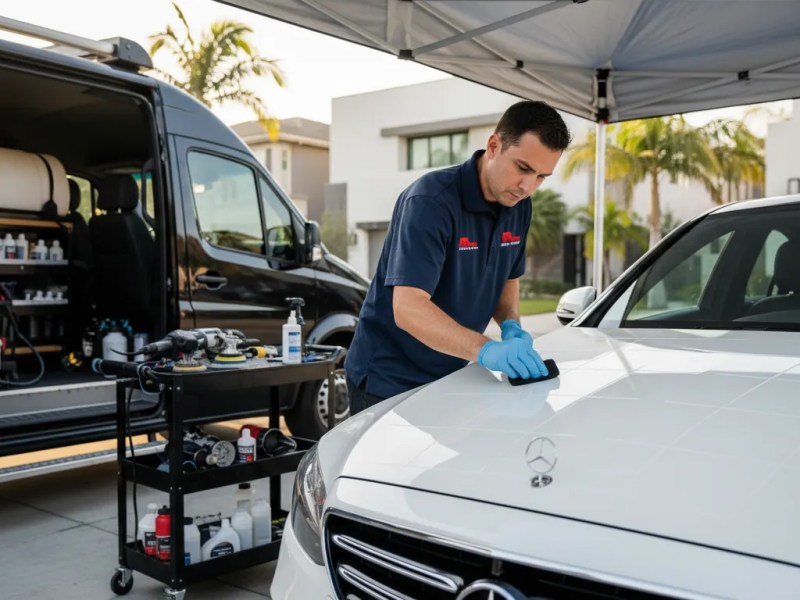
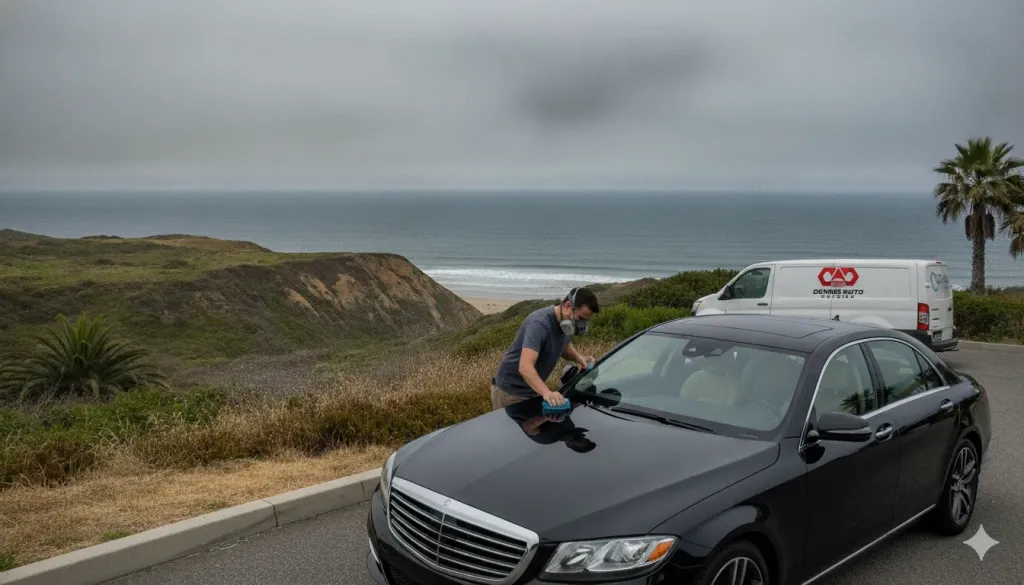
Dennis Auto Details is a fully mobile operation. He brings everything needed — equipment, water supply, power source, professional-grade products — to your driveway, garage, or parking structure in La Jolla, Del Mar, or Rancho Santa Fe. You can see the full list of service areas here.
Here is the step-by-step process for a professional ceramic coating application:
Step 1: Full decontamination wash. The vehicle receives a thorough wash using pH-balanced products, followed by an iron decontamination spray that dissolves embedded metallic particles from the paint surface. This step is non-negotiable — coating over contamination causes premature failure.
Step 2: Clay bar treatment. A clay bar removes bonded surface contamination that the wash cannot reach: industrial fallout, brake dust, and fine road grime. After clay bar, the paint surface is genuinely clean rather than just appearing clean.
Step 3: Paint correction (when needed). Any existing swirl marks, scratches, oxidation, or water spot etching must be removed before the coating goes on. Ceramic coating is not a filler — it amplifies what is already on the surface. Flaws in the paint become permanent flaws under the coating. Most vehicles in La Jolla require at least a 1-step paint correction before coating. Vehicles with more significant surface damage benefit from 2-step paint correction to fully restore clarity before sealing.
Step 4: Panel wipe with IPA. An isopropyl alcohol panel wipe removes all residual oils, silicones, and polish residue. This prepares a completely clean, bondable surface.
Step 5: Coating application. The ceramic coating is applied panel by panel using professional applicators. The product is leveled, allowed to flash, and wiped to a high-gloss finish. The process takes several hours depending on vehicle size.
Step 6: Cure time. The coating requires 24 to 72 hours to fully cure. During this window, the vehicle should stay dry and avoid contact with contaminants. Dennis advises on specific post-application care based on your coating tier.
The entire process typically runs 6 to 10 hours depending on paint condition and vehicle size.
ROI for Luxury Vehicles: The Numbers That Matter
A professional 9-year graphene ceramic coating across San Diego typically runs $1,400 to $2,000+ for most luxury vehicles.
Compare that against the alternatives:
Regular waxing: A quality professional wax job costs $150 to $300 and lasts 3 to 6 months in coastal San Diego conditions. Over 9 years, that is 18 to 36 wax applications — between $2,700 and $10,800 in total spend, with zero permanent protection added to the paint.
Paint correction after neglect: A two-stage paint correction for a vehicle with significant UV oxidation and swirl damage costs $400 to $800. A full respray for panels that have degraded past correction costs $1,500 to $5,000+ depending on the number of panels.
Resale value impact: Pristine paint at trade-in or private sale consistently adds $500 to $2,000 to perceived vehicle value. Buyers inspecting a 5-year-old Porsche with showroom-quality paint versus one with faded, scratched clear coat make faster decisions at higher prices.
The ceramic coating pays for itself in reduced maintenance costs alone. The resale value protection is a bonus.
Tesla and EV Owners in Coastal San Diego
La Jolla has one of the highest concentrations of Tesla vehicles in California. Model 3, Model Y, Model S, and Model X owners have a specific reason to prioritize ceramic coating.
Tesla uses a single-stage paint process that applies paint and clear coat together rather than the multi-stage process used by traditional automakers. This results in a thinner, more vulnerable clear coat that shows swirl marks and UV damage faster than a comparable BMW or Mercedes.
Coastal salt air accelerates this vulnerability. A white Model Y parked outside in Bird Rock or near Windansea Beach will develop surface oxidation and water spotting within 18 to 24 months without protection.
For Tesla owners who want the highest level of care, our luxury car detailing service combined with ceramic coating creates a complete protection package. The hydrophobic surface also makes the car easier to keep clean between washes — important for EV owners who often skip the car wash to protect sensors and cameras.
Del Mar and Rancho Santa Fe: The Same Threats, Different Streets
The environmental conditions that affect La Jolla vehicles apply equally across neighboring North Coastal communities.
Del Mar sits directly on the coast. Vehicles in the Village, west of the 5, and near the Del Mar racetrack face ocean spray exposure and high humidity cycling throughout the year. Our mobile car detailing Del Mar service covers the entire area.
Rancho Santa Fe is inland but receives intense UV exposure and Santa Ana wind events that carry dust, tree debris, and dry air that stresses paint surfaces. The luxury vehicle concentration in Rancho Santa Fe — Ferraris, Maseratis, Rolls-Royces, Range Rovers — makes ceramic coating a standard part of vehicle ownership for many residents. See our dedicated Rancho Santa Fe service area page for more.
Dennis Auto Details serves all three communities directly. He has worked on vehicles in gated estates, underground parking structures, and ocean-view driveways throughout the North Coastal area.
Ceramic Coating Maintenance: Protecting Your Investment
A 9-year graphene coating does not mean 9 years of doing nothing. It means 9 years of dramatically reduced maintenance compared to uncoated paint.
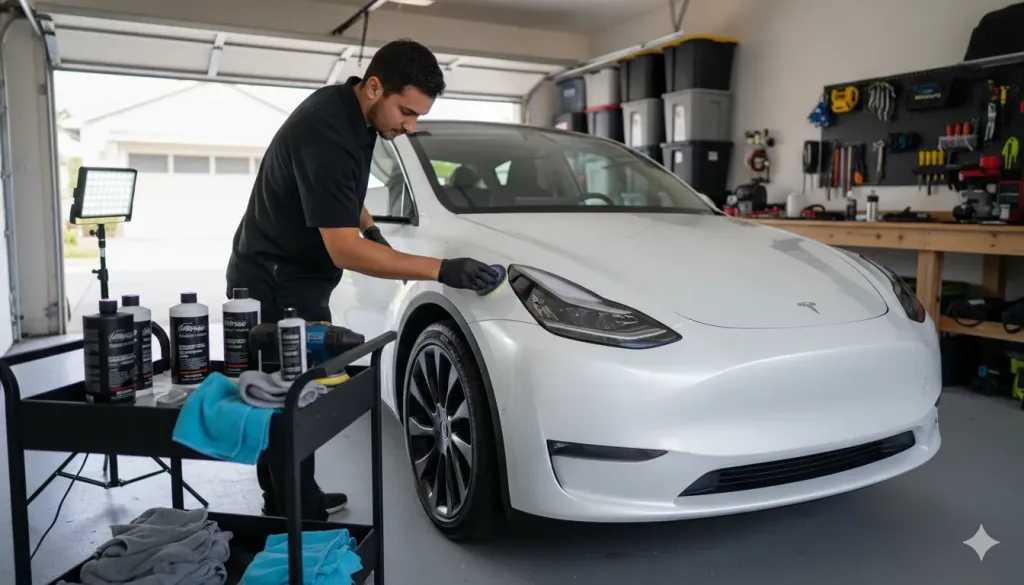
Here is what proper maintenance looks like:
Wash every 2 to 4 weeks using a pH-neutral, coating-safe car shampoo. Automatic car washes with brushes will degrade the coating and should be avoided entirely. Hand wash or touchless wash only.
Apply a ceramic booster spray every 3 to 4 months. A booster restores hydrophobic properties and adds a fresh layer of protection to areas that experience the most wear.
Address contaminants immediately. Bird droppings and tree sap should be removed within a few hours, even on a coated surface. They are less damaging on ceramic, but they still carry acids that will eventually affect the coating.
Schedule an annual maintenance check. Dennis Auto Details offers follow-up inspections to assess coating condition and recommend maintenance treatments as needed.
With proper care, your 9-year coating delivers exactly what it promises. Want to understand how long different coating tiers last under real San Diego conditions? Read our full guide on how long ceramic coating lasts in San Diego. Skip the maintenance and the lifespan shortens.
Book Ceramic Coating for Your La Jolla or Del Mar Vehicle
Dennis Auto Details is 3M, Meguiars, and Rupes certified, fully insured, and has 350+ Five-Star Reviews across San Diego County. He comes directly to your home, office, or parking structure — no shop drop-off required.
Ceramic Coating Options:
- 2-Year Ceramic Coating: starting at $600–$900
- 5-Year Ceramic Coating: $900–$1,400
- 9-Year Ceramic Coating (including graphene): starting at $1,400–$2,000+
Book your appointment today:
- Online: https://dennisautodetails.fieldd.co/
- Phone: 858-295-7259
- Contact: https://dennisautodetails.com/contact-us/
Find us on Google Maps:
A 10% non-refundable deposit is required at booking. A 4% card transaction fee applies.
Key Takeaways
- La Jolla, Del Mar, and Rancho Santa Fe vehicles face salt air, UV Index 8–11, marine layer, and coastal contaminants that degrade paint faster than inland areas.
- Ceramic coating creates a semi-permanent protective barrier that blocks UV, repels salt water, and resists chemical etching.
- Graphene ceramic coating offers superior heat dispersion, anti-static properties, and a 9-year lifespan — the correct choice for luxury vehicles.
- The application process includes decontamination, clay bar, paint correction, IPA wipe, and coating application — performed entirely at your location.
- A 9-year coating investment of $1,299–$1,799 outperforms years of wax maintenance and protects resale value by $500–$2,000+.
- Dennis Auto Details is mobile, certified, and serves all North Coastal San Diego communities.
FAQ
Is ceramic coating safe for all luxury vehicle paint types, including exotic cars? Yes. Professional ceramic coating applied with proper prep is safe on all OEM and custom paint finishes including matte, satin, and single-stage paint. The prep process — particularly paint thickness measurement and IPA wipe — ensures the coating bonds correctly without damaging specialty finishes.
How long does the appointment take at my La Jolla home? A full ceramic coating service including paint correction runs 6 to 10 hours depending on vehicle size and paint condition. Dennis will confirm a time estimate when you book based on your specific vehicle.
Can I still drive my car the same day? The coating needs 24 to 48 hours of dry conditions to cure properly after application. Dennis will advise you on the specific post-service window for your chosen coating tier.
Do I need paint correction before ceramic coating? Most vehicles in La Jolla and Del Mar need at least a one-step correction before coating. Salt air exposure and UV damage accumulate over time and create surface defects that the coating will lock in permanently if not addressed first. Dennis assesses paint condition and recommends the appropriate prep level.
Does ceramic coating prevent rock chips? No. Ceramic coating adds scratch resistance against fine surface contact but does not stop rock chips or deep physical impacts. For rock chip protection, paint protection film (PPF) combined with ceramic coating is the recommended approach for high-value vehicles.

Something went wrong. Please refresh the page and/or try again.