
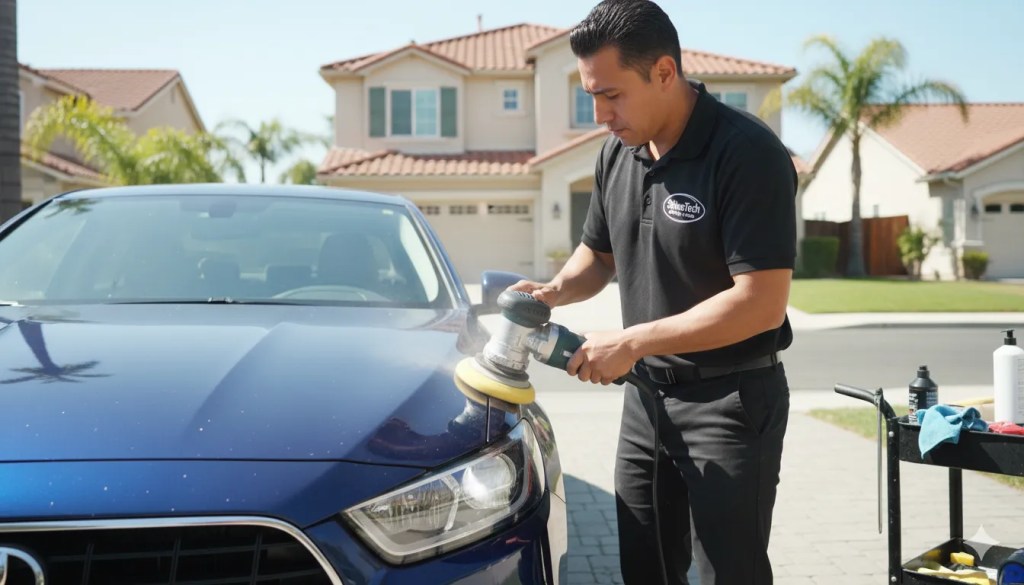
Car Detailing vs. Paint Correction: What’s the Difference?
TL;DR
- Auto detailing cleans, protects, and restores your car’s appearance — but it doesn’t remove paint defects like swirl marks, scratches, or oxidation.
- Paint correction uses machine polishing to remove surface defects from within the clear coat — it restores the paint itself, not just the surface.
- Most San Diego vehicles with three or more years of use benefit from paint correction, especially those exposed to UV, automatic car washes, or dusty inland conditions.
- Many paint correction jobs include full interior and exterior detailing as part of the package — and paint correction is required before ceramic coating.
Walk into any detailing shop and ask the difference between detailing and paint correction. You’ll get a different answer from almost every one. The terms get used interchangeably online, in ads, and even by some detailers — but they describe two completely different services with different tools, different outcomes, and different price points.
If you’re trying to figure out what your car actually needs, this is the article that clears it up. No fluff, no sales pitch — just an honest breakdown of what each service does, when you need one versus the other, and what the combination looks like.
What Auto Detailing Covers
Auto detailing is the comprehensive cleaning, protection, and surface restoration of a vehicle. It goes far beyond a car wash. A full detail addresses every interior and exterior surface with professional-grade products and tools.
Exterior detailing typically includes:
- Hand wash and dry
- Clay bar decontamination (removes bonded surface fallout)
- Paint surface wipe-down
- Wax, sealant, or ceramic spray application
- Tire and wheel cleaning
- Glass cleaning and treatment
- Trim restoration
Interior detailing typically includes:
- Vacuuming carpets, seats, and trunk
- Steam or chemical cleaning of upholstery
- Dashboard, console, and door panel wipe-down
- Leather conditioning (if applicable)
- Glass cleaning
- Odor treatment if needed
At Dennis Auto Details, the Standard Full Detail starts at $229. The Complete Full Detail starts at $339 and the Luxury Full Detail starts at $549.
A detail makes your car look, smell, and feel clean. It protects surfaces. It removes surface contamination. But it does not fix paint defects that live inside the clear coat layer — swirl marks, scratches, oxidation, and water spot etching. For those, you need paint correction.
What Paint Correction Does
Paint correction is a machine polishing process that removes microscopic surface defects from within the clear coat. It’s not a cleaning step — it’s a restoration step.
Your car’s clear coat is a transparent layer of hard paint that sits over the color. It’s what gives paint its gloss and protects the color underneath. Over time, that clear coat accumulates:
- Swirl marks from improper washing technique or automatic car washes
- Fine scratches from dust abrasion, wiper blades, and contact
- Oxidation from prolonged UV exposure without protection
- Water spot etching from hard water minerals baking in the sun
These defects scatter light instead of reflecting it evenly. That’s why a three-year-old car in San Diego looks dull in direct sunlight even after a fresh wash — the light can’t reflect cleanly off a marred surface.
Paint correction uses a rotary or dual-action machine polisher with abrasive compounds and polishes to level the clear coat surface. Each pass removes a microscopic layer of clear coat — and with it, the defects that live in that layer. When the surface is flat and uniform, light reflects evenly again and the paint looks deep, glossy, and clear.
For a technical look at how compounds and polishes work in the correction process, Autogeek’s guide to compounds and polishes covers the abrasive stages clearly.
The Key Difference, Stated Plainly
Detailing cleans what’s on the surface. Paint correction removes defects from within the surface.
A detail can wipe dust off a swirl mark. It cannot remove the swirl mark.
Paint correction removes the swirl mark — permanently. But it doesn’t replace the cleaning, protection, and interior work that detailing includes.
That’s why the two services aren’t competitors. They address different layers of the vehicle. Many professional jobs include both.
When You Need Detailing Only
Detailing is the right service when your paint is in sound condition and you need cleaning and protection — not defect removal.
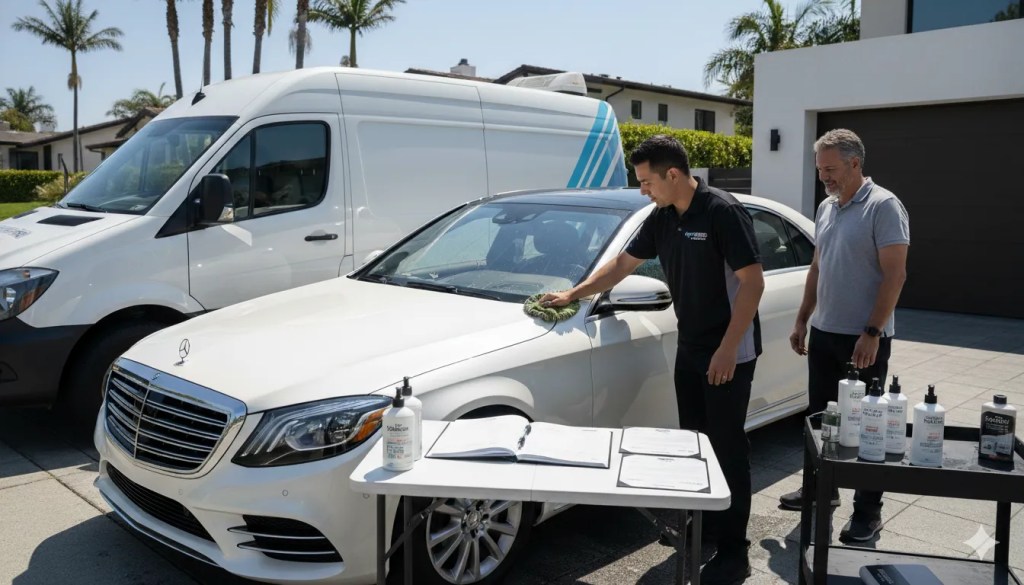
These are the situations where detailing alone is the correct call:
- Routine maintenance: Your car gets detailed every 3–6 months and the paint is protected. A detail refreshes the protection layer.
- Light contamination buildup: The car looks dull from road film, bird droppings, and water spots that haven’t etched into the paint yet.
- Interior-focused need: The cabin needs deep cleaning — pet hair, odor, stained seats — and the exterior paint is in good shape.
- Pre-sale preparation: You’re selling the car and want it looking clean and fresh without investing in correction.
For San Diego drivers with newer vehicles or vehicles already protected with a ceramic coating or sealant, an exterior detail or interior detail is often all that’s needed between correction services.
When You Need Paint Correction First
Paint correction is the right starting point when the clear coat has visible defects — or when you’re about to apply a ceramic coating.
Book paint correction when you see any of these:
- Swirl marks visible in sunlight: If you can see circular scratching patterns when the sun hits the paint at an angle, the clear coat is marred. A detail won’t fix it.
- Dull or flat finish: A car that looks clean but doesn’t reflect clearly has oxidation or micro-marring in the clear coat.
- Water spot etching: Hard water minerals that dried and baked onto paint often etch into the clear coat. Clay bar removes surface contamination — it doesn’t remove etching.
- Pre-ceramic coating prep: This is non-negotiable. Ceramic coating bonds to and locks in your paint’s current condition. Any swirl marks or defects present during application stay permanently sealed underneath the coating. Correction must happen first.
- Coming out of storage: Vehicles that sat for six months or more often show surface oxidation and contamination that needs correction before protection.
- Dealer lot swirls on a new car: New vehicles from dealerships often arrive with swirl marks from automatic car washes and improper detailing during lot prep.
Dennis offers both 2-step paint correction and gloss enhancement services. The right stage depends on the severity of the defects on your specific vehicle.
For Chemical Guys’ breakdown of the paint correction process and what it fixes, their step-by-step paint correction guide is a thorough reference.
The Combination Service
Most professional-level correction jobs include full detailing as part of the process. The paint can’t be corrected without being washed and decontaminated first. The interior and wheels get cleaned as part of the service scope.
At Dennis Auto Details, when you book paint correction in San Diego, the process includes:
- Full exterior wash and decontamination
- Clay bar treatment to remove bonded fallout
- Machine polishing (1-step gloss enhancement or 2-step paint correction depending on defect severity)
- Finishing polish to maximize gloss
- Interior cleaning
- Ceramic coating application (if added)
The result is a vehicle that’s been cleaned and corrected — not one or the other.
Cost Difference Between Detailing and Paint Correction
The price gap reflects the labor and time difference.
A standard full detail requires several hours and covers a broad range of surfaces. Paint correction requires a multi-hour or full-day commitment focused specifically on the paint, using professional polishers, multiple compounds, and significant technical skill.
Dennis Auto Details current pricing:
- Standard Full Detail: $229+
- Complete Full Detail: $339+
- Luxury Full Detail: $549+
- Paint Correction: priced by vehicle and stage — contact for assessment
Paint correction pricing varies because defect severity, vehicle size, and the number of correction stages directly affect labor time. A sedan with light swirls needs different work than a full-size SUV with heavy oxidation from years of outdoor parking in Escondido.
A 10% non-refundable deposit is required at booking. A 4% card transaction fee applies to card payments.
San Diego Makes Paint Correction More Common Than You’d Expect
San Diego has 266+ sunny days per year with a UV index of 8–11 for most of the year. Automatic car washes — common in busy neighborhoods like Chula Vista, El Cajon, and National City — are the single biggest cause of swirl marks on daily drivers. Coastal salt air in La Jolla, Pacific Beach, and Coronado degrades sealants faster than inland environments.
The result: most San Diego vehicles with three or more years of use are candidates for paint correction. Many show visible marring under direct sunlight that the owners haven’t noticed because they rarely see the car in strong direct light.
Dennis performs a paint assessment before any correction service. He checks paint condition under direct lighting, evaluates defect depth, and recommends the right correction stage.
What a San Diego Customer Said
“My car looks absolutely incredible. Dennis was so thorough and took his time to make sure every inch of my car was perfect. I have a white car and it literally looks like it just came off the showroom floor. He was very professional and communicated well throughout the whole process.” — Sophie Exdell, Dennis Auto Details customer
Ready to Find Out Which Service Your Car Needs?
Book an assessment and let Dennis evaluate your paint in person.
Book online: dennisautodetails.fieldd.co
Call or text: 858-780-4515
Contact form: dennisautodetails.com/contact-us
Find Dennis on Google Maps: San Diego | Rancho Bernardo
Related Services
- Paint Correction San Diego
- Full Detail San Diego
- Interior Detail San Diego
- Exterior Detail San Diego
- Ceramic Coating San Diego
- Mobile Detailing San Diego
Key Takeaways
- Detailing cleans, protects, and restores the surface of your car inside and out. It does not remove paint defects from within the clear coat.
- Paint correction uses machine polishing to remove swirl marks, scratches, oxidation, and water spot etching from within the clear coat — restoring true gloss and clarity.
- You need detailing for routine maintenance, light buildup, and interior cleaning when paint is in good condition.
- You need paint correction when you see swirl marks, dull paint, etching, or you’re preparing for ceramic coating.
- San Diego conditions — UV, automatic car washes, salt air, and inland dust — make most 3+ year old vehicles candidates for correction.
- Dennis Auto Details is fully mobile and serves all San Diego neighborhoods with same-day availability on select dates.
FAQ
Does paint correction remove deep scratches? It depends on scratch depth. Paint correction removes defects that live within the clear coat layer. If a scratch goes through the clear coat and into the color or primer, machine polishing won’t fully remove it — it requires touch-up or panel respray. Dennis evaluates scratch depth before the correction service.
Is paint correction a one-time service? Not necessarily. Paint quality after correction depends heavily on how you protect and maintain it. A ceramic coating after correction locks the surface in and prevents new defects from forming easily. Without protection, swirl marks and marring return with regular washing and use.
How long does paint correction take? A 1-step gloss enhancement typically takes 4–6 hours depending on vehicle size. A 2-step paint correction takes longer — often a full day for a sedan, and longer for trucks, SUVs, or luxury vehicles with more surface area. Dennis gives a time estimate during booking.
Can I get paint correction on a leased vehicle? Yes. Paint correction is non-damaging when performed by a professional using proper technique. It actually improves the condition of the paint and can reduce wear-and-tear charges at lease return. Dennis applies only the correction stage necessary — he won’t over-polish.
Do I need to come to a shop for paint correction? No. Dennis Auto Details is fully mobile and performs paint correction at your location anywhere in San Diego County. He brings his own lighting, polishers, and supplies.
Image Prompts
Image 1: Prompt: Split-screen comparison of two identical silver sedans in San Diego sunlight — left shows swirl-marred, dull paint with no reflection clarity; right shows the same car after paint correction with deep, mirror-like gloss. Alt text: Before and after paint correction on silver sedan in San Diego — swirl marks removed, deep gloss restored
Image 2: Prompt: Close-up of a professional mobile detailer using a dual-action polisher on the hood of a dark green BMW, with a portable LED detailing light illuminating swirl marks on the paint surface. Alt text: Mobile detailer using machine polisher for paint correction on BMW in San Diego driveway
Image 3: Prompt: Macro shot of swirl marks visible on a black car hood under a bright detailing light, showing the circular scratch pattern in the clear coat before correction. Alt text: Swirl marks visible on black car paint clear coat before paint correction service
Image 4: Prompt: A Dennis Auto Details mobile detailer conducting an exterior paint inspection on a white Porsche Cayenne in a Rancho Santa Fe driveway, using a high-intensity flashlight to assess paint defect depth. Alt text: Paint correction assessment on Porsche Cayenne by Dennis Auto Details mobile detailer in San Diego