
How to Clean Car Seats: A Complete Guide for Fabric, Leather, and Vinyl
TL;DR
- Car seats are the dirtiest surface in most vehicles — and most people underestimate the buildup
- Fabric, leather, and vinyl each require different cleaning methods and products
- Common mistakes — too much water, wrong cleaners, skipping dry time — cause more damage than the original mess
- San Diego’s UV and beach lifestyle accelerate seat wear; professional cleaning extends their life
Your steering wheel gets wiped down. Your dashboard gets dusted. But your car seats? They absorb everything — spilled coffee, sunscreen, pet hair, crumbs, sweat, and whatever mystery substance your kids tracked in from the park.
The average driver sits in their car for more than an hour a day. That means your seats take more contact than almost any other surface in your life — including your couch. Yet most people don’t clean them nearly as often as the wear requires.
Here’s the complete guide on how to clean car seats the right way, without causing damage in the process.
Know Your Seat Type Before You Start
The single most important rule in car seat cleaning: the wrong product on the wrong material causes permanent damage.

Before you grab a cleaner, identify what your seats are made of.
Fabric (cloth) seats — the most common type. They absorb stains quickly and trap odors in the fibers. They respond well to carpet-style cleaners, upholstery foam, and steam.
Leather seats — found in mid-range and luxury vehicles. Leather is durable but dries out and cracks without proper conditioning. Harsh cleaners strip the natural oils and protective coating. San Diego’s UV exposure accelerates this process significantly.
Vinyl seats — common in trucks, older vehicles, and base trims. Vinyl looks similar to leather but is synthetic. It’s more water-resistant but can crack with prolonged UV exposure and the wrong products.
Leatherette / synthetic leather — a hybrid material increasingly common in modern vehicles. Treat it like leather: pH-safe cleaner, no harsh scrubbing.
Consumer Reports recommends that drivers use automotive-specific cleaners rather than household products — because household products aren’t formulated for car finishes and can cause permanent damage.
What You’ll Need
For a solid DIY clean, you don’t need a full detailing kit. Start with:
- Vacuum with crevice tool and upholstery brush attachment
- Soft-bristle brush (for fabric) or microfiber applicator (for leather)
- Upholstery cleaner or all-purpose interior cleaner (fabric)
- pH-neutral leather cleaner (leather/leatherette)
- Leather conditioner
- Multiple clean microfiber towels
- Spray bottle with water
- Wet/dry vacuum or clean towels for extraction
Step-by-Step: Cleaning Fabric Car Seats
Step 1: Vacuum thoroughly
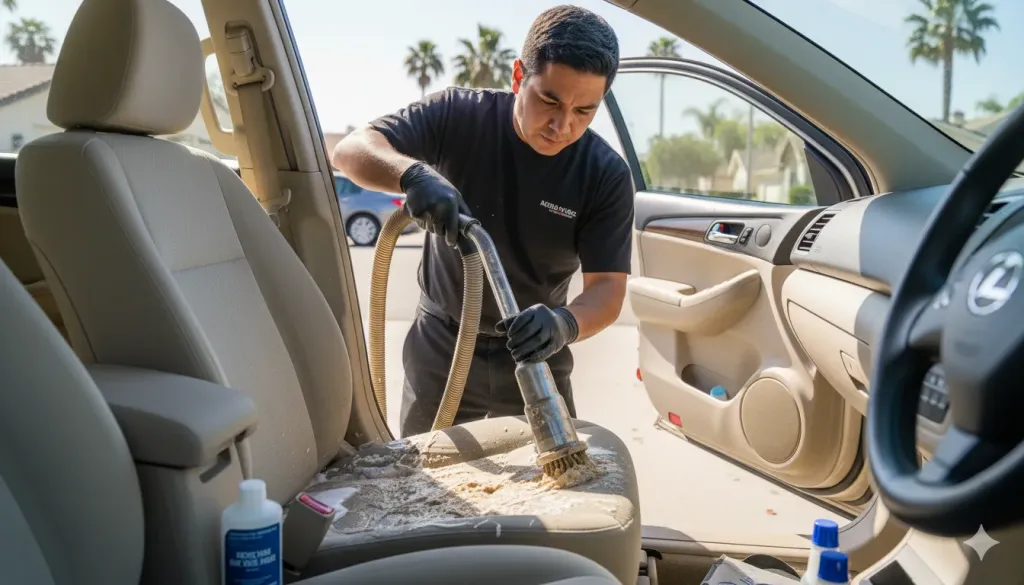
Start with a full vacuum of the seat surface, crevices, and seat back. Use the crevice tool along the seam where the seat cushion meets the back — this is where crumbs, pet hair, and debris accumulate most. Remove floor mats and vacuum underneath them too.
Step 2: Pre-treat stains
Spray upholstery cleaner directly onto stains and let it sit for 3–5 minutes. Don’t rub yet — let the product penetrate the fibers first. For stubborn stains, a small amount of diluted dish soap on a soft brush works as a starter treatment.
Step 3: Scrub and agitate
Use a soft-bristle brush in small circular motions. Work from the outside of the stain inward to prevent spreading. Apply light, consistent pressure. For embedded grime across the full seat, work section by section.
Step 4: Wipe and extract
Use a clean microfiber towel to blot the area — don’t rub. If you have a wet/dry vacuum, use it to extract moisture and cleaner residue. This step matters: leaving cleaner in the fabric causes yellowing and can attract new dirt faster.
Step 5: Dry completely
Crack the windows or park in a well-ventilated area. Never close up a car with wet seats — trapped moisture causes mildew. Drying typically takes 2–4 hours in San Diego’s climate.
For pet hair embedded in fabric, check out the pet hair removal guide from Dennis Auto Details — a vacuum alone rarely gets it all. If stains on the seats are paired with persistent odors, an ozone treatment addresses the odor source that shampooing alone can’t reach.
Step-by-Step: Cleaning Leather Car Seats
Step 1: Vacuum first
Same as fabric — get the loose debris out before applying any liquid. Leather scratches easily, so trapped grit under a cleaning cloth can leave marks.
Step 2: Apply pH-neutral leather cleaner
Spray a small amount onto a microfiber applicator or soft cloth — never directly onto the seat in large quantities. Work the product into the surface using light circular motions. A little goes a long way.
Step 3: Wipe clean
Use a dry microfiber towel to remove the cleaner residue. Work in small sections to make sure no product is left sitting on the surface.
Step 4: Condition the leather
This step is non-negotiable, especially in San Diego. Apply a quality leather conditioner using an applicator pad, working it evenly across the seat. Let it absorb for 5–10 minutes, then buff lightly with a clean microfiber cloth. Conditioning restores moisture and prevents cracking.
Step 5: Avoid direct sun while drying
Don’t park in full sun immediately after cleaning and conditioning leather. Give it 20–30 minutes in shade or indoors before the car heats up.
For a deeper look at leather-specific care, the leather car seat cleaning and conditioning guide covers everything from product selection to long-term protection. Owners of luxury vehicles should pay particular attention — the leather in high-end cars often has specialized coatings that require brand-specific care.
Jalopnik’s detailing experts agree: apply leather cleaner to a cloth first rather than directly to the seat to prevent saturation around seams and stitching.
Common Mistakes That Damage Car Seats
Using too much water on fabric
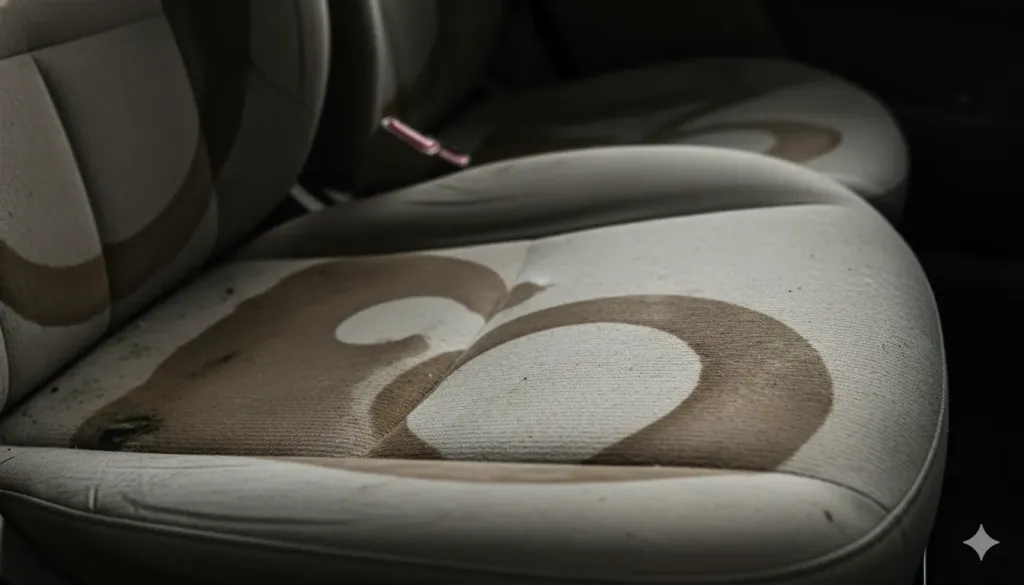
Oversaturation pushes dirt deeper into the foam and backing. It also creates the perfect environment for mold. Use cleaners sparingly and extract thoroughly.
Using household cleaners on leather
Windex, dish soap, and all-purpose spray cleaners are often too alkaline for leather. They strip protective coatings and cause drying and cracking over time. Use products specifically formulated for automotive leather.
Skipping dry time
The most overlooked step. Rolling the windows up and parking a car with damp seats is how mildew starts. In San Diego, even a slightly damp interior bakes in the heat — that combination accelerates odor development fast.
Scrubbing too aggressively on leather
Hard scrubbing breaks down the leather surface finish. Use light pressure and let the product do the work.
Ignoring the seat crevices
The gap between the seat cushion and back is where most contamination hides. Skipping this area means a partial clean at best.
Chemical Guys, whose professional formulas are used by detailers nationwide, point out that allowing seats to air dry fully with cracked windows is essential to prevent mildew — especially after a deep clean with significant moisture.
San Diego Seat Wear: What Makes It Worse Here
San Diego drivers deal with seat wear factors that aren’t as common in other climates:
UV exposure — San Diego averages 266 sunny days a year. Leather seats in a sun-facing car fade and dry out significantly faster than in cloudy climates. UV-protective leather conditioners are worth the investment here.
Beach lifestyle — Salt, sand, and wet swimwear are brutal on upholstery. Sand acts like sandpaper on fabric fibers, and saltwater residue on leather draws moisture out of the material.
Year-round use — There’s no offseason in San Diego. Cars here get used 12 months a year, which means seat wear accumulates faster than in places where vehicles sit through winter.
After a beach trip, the post-beach detailing guide walks through exactly how to remove salt and sand from your interior without causing further damage. Pair seasonal seat cleaning with a summer car detailing strategy to stay ahead of cumulative wear throughout the year.
The Standard Interior Detail at Dennis Auto Details covers deep cleaning of all surfaces including thorough seat treatment, starting at $179. For serious buildup or pet contamination, the Luxury Interior Detail ($319+) includes seat shampoo and extraction equipment.
When Professional Cleaning Is the Right Call
DIY cleaning handles routine maintenance well. But there are situations where professional equipment and products produce results that home methods can’t:
Deep-set stains — Stains that have dried and set into the foam require steam penetration or professional extraction tools to lift completely.
Pet contamination — Urine, heavy dander, and embedded pet hair require commercial-grade equipment. The seat shampooing service extracts what a home vacuum and scrub brush can’t reach.
Mold or mildew — If you can see or smell mold, this is beyond DIY territory. Mold spreads into the seat padding and requires professional treatment and possibly ozone treatment to address the odor source.
Pre-sale preparation — Buyers judge interiors immediately. A professional seat clean before listing your vehicle is one of the highest-ROI steps you can take. Combine it with a Complete Detail ($339+) for near-showroom results. Review the interior detailing cost guide to pick the right package for your situation.
What San Diego Customers Are Saying
“These guys are AH-MAZING!!! They got all the dog hair out of my 2020 Jeep Wrangler, which let me tell you was no small task with 3 dogs. The hair was embedded in the seat and carpet. The inside literally looks brand new now.” — T, Google Review
“Dennis did a fantastic detail service on my vehicle! It looks brand new! He is very professional, courteous, and highly recommended!!” — Lizette Bekendam, Google Review
Book Interior Detailing in San Diego
Dennis Auto Details provides mobile interior detailing across San Diego County, including seat shampooing, steam cleaning, and full interior reconditioning — all at your home or office. Service areas include Carlsbad, Del Mar, Rancho Bernardo, Encinitas, Scripps Ranch, and more.
Interior Detail packages start at $179. Same-day availability is often possible.
Book your interior detail online or call 858-295-7259.
Find us on Google Maps — San Diego or Google Maps — Rancho Bernardo.
Key Takeaways
- Identify your seat material before selecting any product — the wrong cleaner causes permanent damage
- Fabric seats need thorough vacuuming, targeted stain treatment, and complete drying
- Leather seats require pH-neutral cleaners and conditioner after every cleaning
- Skipping the drying step is how mildew starts — always allow full ventilation
- San Diego’s sun and beach lifestyle accelerate seat wear; seasonal professional cleaning extends seat life
- Deep stains, pet contamination, mold, and pre-sale prep all call for professional service
Frequently Asked Questions
Can I use dish soap to clean fabric car seats?
A small amount of diluted dish soap can work as a starter stain treatment on fabric seats, but it shouldn’t be your primary cleaner. It’s too alkaline for repeated use on upholstery and can leave residue that attracts dirt. Use automotive upholstery cleaners for best results.
How often should I clean my car seats?
A basic vacuum every 2–4 weeks keeps debris from building up. A more thorough cleaning every 3 months is a good baseline for most San Diego drivers. After beach trips, camping, or significant pet use, clean sooner.
Will steam cleaning damage my leather seats?
Professional steam cleaning on leather requires proper technique and distance. DIY steam cleaning with consumer units can damage leather if applied incorrectly. Professional detailers calibrate temperature and distance to clean effectively without damage.
What is the best car seat cleaner for pet stains?
Enzyme-based upholstery cleaners break down organic stains from pets most effectively. For embedded hair, professional extraction equipment is necessary. Dennis Auto Details offers pet hair removal as an add-on service.
Can stains on leather seats be removed permanently?
It depends on the stain type, how long it’s been there, and whether the leather’s protective coating is intact. Fresh stains on well-maintained leather often come out cleanly. Old, set-in stains may improve but not fully disappear. Dennis Auto Details will assess your seats and set realistic expectations before any service.



Something went wrong. Please refresh the page and/or try again.