

Paint Correction Before Ceramic Coating in San Diego — Do You Actually Need It?
TL;DR: Ceramic coating locks your paint’s current condition in place permanently. If your paint has defects — swirl marks, scratches, oxidation — the coating amplifies and preserves every one of them. Paint correction before ceramic coating removes those defects first, so the coating seals in a perfect surface instead of a flawed one. Here’s how to know if you need correction, when you can skip it, and what a combined service from Dennis Auto Details looks like.
Why Sequence Matters Before Ceramic Coating
Here’s the core truth about ceramic coating: it’s a glass-like layer that bonds to the surface underneath and locks that surface in place.
If your paint is in excellent condition, the coating enhances it. If your paint has swirl marks, scratches, haze, or oxidation, the coating seals all of those defects in — and the high-gloss amplification effect of the coating actually makes them more visible, not less.
This is why professional installers assess paint condition before recommending a coating package. Applying a 5-year or 9-year ceramic coating over damaged paint means paying premium money to permanently preserve a flawed surface. That’s not protection. That’s an expensive mistake.
The right sequence is: assess the paint, correct what needs correcting, then coat the corrected surface. Done in that order, ceramic coating performs exactly as advertised — locking in deep gloss and protecting a flawless finish for years.
Why Coating Amplifies What’s Underneath
Think of ceramic coating as a transparency film. A transparency placed over a printed image makes colors richer and detail sharper — but it also makes every imperfection in that image more visible.
The high-gloss, optically clear layer of ceramic coating creates more intense light reflection off the paint surface. That reflection reveals defects that might have been subtle before. Swirl marks that looked minor under normal lighting become obvious spider-web patterns under direct sunlight. Faint haze becomes a washed-out cast across entire panels.
San Diego’s bright, high-UV environment makes this effect even more pronounced. Year-round sunshine means your vehicle spends most of its life in the exact lighting conditions that reveal paint defects most clearly. A car that looks acceptable in a parking garage looks completely different in La Jolla sunlight.
Paint correction before coating solves this by removing the defects before the coating amplifies them. Good paint under coating looks remarkable. Corrected paint under coating looks even better. This is why at Dennis Auto Details, the 5-Year and 9-Year coating packages include 1-Step and Deep Paint Correction respectively — it’s built into the process for a reason.
How to Assess Your Paint Condition Before Deciding
You don’t need professional equipment to do an initial assessment. These four methods give you a clear picture of your paint’s condition before committing to a service tier.

Parking lot inspection in direct sunlight Move your vehicle into direct sunlight and stand at a low angle to flat panels — the hood, roof, and trunk lid are most revealing. Look for swirling patterns, haze, or uneven reflections. Dark-colored vehicles show these most clearly, but even silver or white paint will show texture differences and inconsistent shine levels in proper lighting.
The clay bar drag test Run a clean clay bar lubricated with a detail spray across a small panel section. A smooth glide indicates clean, contaminant-free paint. A gritty, dragging feel means the surface has embedded iron fallout, brake dust, rail dust, or industrial contamination bonded into the clear coat. Contaminated paint must be decontaminated before coating, and heavy contamination often indicates a paint condition that benefits from correction first.
Paint thickness gauge reading A professional paint thickness gauge measures the depth of clear coat remaining on each panel. This matters because correction removes clear coat — and some vehicles, particularly those that have been polished multiple times or had panel respray work, may have reduced clear coat depth. A gauge reading tells the technician how aggressively they can correct without thinning the clear coat too far. Dennis’s technicians perform this assessment as a standard first step before any correction work begins.
The finger scratch test Lightly drag a clean fingernail across a painted surface at an angle. If the scratch appears and then seems to disappear as you look away, it’s likely in the clear coat and correctable. If the scratch stays clearly visible and shows a different color beneath, it has broken through to the base coat and requires paint touch-up rather than polishing. In that case, headlight restoration and other prep services can be evaluated alongside correction to get the vehicle fully ready for coating.
When Paint Correction Is Required Before Coating
These conditions make correction non-optional before ceramic coating:
Heavy swirl marks across multiple panels. If the swirl pattern is visible from a normal standing distance — not just from a low angle in direct light — the coating will amplify that damage to an unacceptable degree. Professional paint correction is necessary.
Oxidation on the clear coat surface. Oxidized paint is chalky, dull, and physically degraded. Applying ceramic coating over oxidized paint achieves poor adhesion and traps the damaged layer. The oxidation must be removed by polishing before coating can bond properly.
Deep marring or buffer trails from previous bad polishing. If a previous detailer used an overly aggressive compound without a proper finishing step, they may have left holograms or heavy swirl patterns. These are actually worse than original swirls and require correction before they get locked in permanently.
Visible scratches in direct light at standing distance. Light scratches within the clear coat layer are correctable. If they’re visible without crouching down and examining the panel closely, they’ll be obvious post-coating.
Detailed Image, one of the most respected professional detailing resources in the industry, notes that a fully corrected surface is what separates a below-average detail from a great one — and that “fixing what you cannot see” is what determines long-term coating performance. For any of the conditions above, paint correction is not an upsell — it’s the required first step.
When Paint Correction Is Optional

Not every vehicle needs intensive correction before coating.
Newer vehicles with well-maintained paint often need only a gloss enhancement polish or thorough decontamination before coating application. If a 1 or 2-year-old car has been hand-washed consistently with proper technique and shows no visible swirling under direct light, light prep work is sufficient.
Vehicles with light, localized damage may not require full correction across all panels — a targeted approach corrects affected areas without treating the entire vehicle.
In these cases, Dennis’s technicians will recommend the appropriate prep level honestly. The 2-Year Ceramic Coating includes a 1-Step Paint Polish/Enhancement — appropriate for vehicles already in good shape. The 5-Year Ceramic Coating includes a 1-Step Paint Correction removing 50–60% of defects. The 9-Year Ceramic Coating includes a Deep Paint Correction removing 65–75% of defects — suited for vehicles where the highest level of results is expected.
The goal is always the right service for your vehicle’s actual condition, not the most expensive option.
The Combined Service: Paint Correction + Ceramic Coating in San Diego
When a vehicle needs both services, Dennis Auto Details performs them as a single combined appointment — which produces better results and better value than scheduling them separately.
According to Autogeek, the preparation stage is where the real work happens — coating application itself is straightforward, but the surface preparation (wash, decontamination, clay treatment, correction, IPA wipe) determines whether a coating performs as it should over its full rated lifespan. Dennis’s combined appointment executes every step of that preparation correctly, once, in the right order.
Here’s what the combined process includes:
Step 1 — Paint Assessment and Thickness Measurement: Inspection under directional lighting, paint thickness measurement across all panels, and determination of the correct correction level.
Step 2 — 4-Step Deep Wash and Decontamination: Foam wash, iron decontamination (removes bonded metallic fallout), clay bar treatment (removes bonded surface contamination), and a final IPA wipe-down to strip any remaining residue.
Step 3 — Paint Correction: Depending on the package and vehicle condition — Gloss Enhancement, 1-Step, or 2-Step machine polishing. Each panel is worked systematically and inspected under light after completion.
Step 4 — Final Surface Prep: IPA panel wipe removes all polish residue and oils. This ensures the ceramic coating bonds directly to bare, corrected paint.
Step 5 — Ceramic Coating Application and Curing: The coating is applied panel by panel. Curing requires keeping the vehicle away from water and contaminants for a period after application.
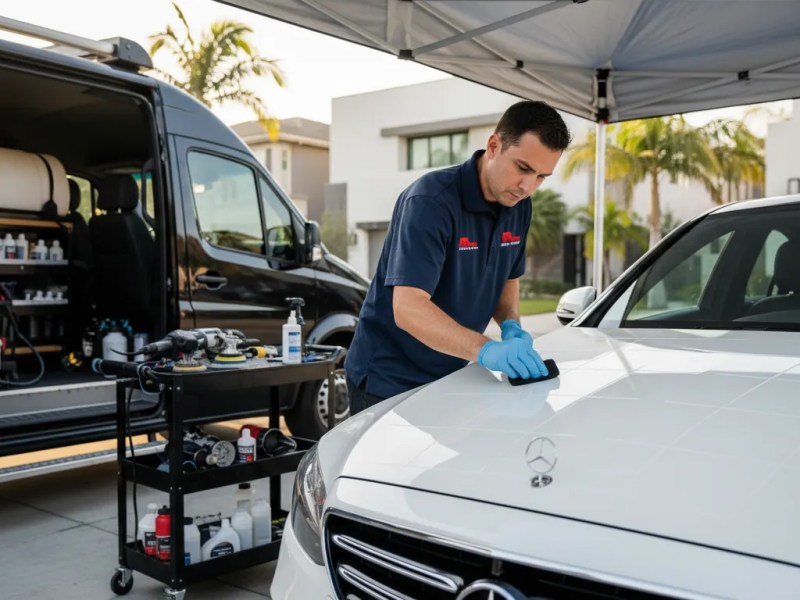
Total service time: A combined appointment typically takes 6 to 12 hours depending on vehicle size, correction level, and coating tier. Dennis’s mobile service performs this at your San Diego location — home, office, or wherever is convenient.
This approach works equally well for luxury car detailing clients with Porsche, BMW, or Tesla vehicles where paint quality expectations are highest, and for standard vehicles where owners want a long-lasting, low-maintenance finish.
⭐ “GTL shared: ‘Had my truck detailed with the 2 year ceramic coating. The truck came out beautifully and looked like glass. There was no rushing through the job, they took their time and did a fantastic job.’”
Pricing for Paint Correction and Ceramic Coating Combined

Ceramic coating packages at Dennis Auto Details already include paint prep and polishing:
| Package | Paint Prep Included | Defect Removal | Warranty |
|---|---|---|---|
| 2-Year Ceramic Coating | 1-Step Polish/Enhancement | 20–30% | 2-Year Manufacturer Warranty |
| 5-Year Ceramic Coating | 1-Step Paint Correction | 50–60% | 5-Year Product Warranty |
| 9-Year Ceramic Coating | Deep Paint Correction | 65–75% | 9-Year Product Warranty |
For vehicles that need standalone 2-Step Paint Correction before a coating package, that service is priced at $650–$750. Dennis will advise during the initial assessment whether the included correction level in your chosen package is sufficient, or whether additional correction work is appropriate first.
Combining paint correction and ceramic coating in a single appointment eliminates duplicate prep steps — you only do the decontamination wash once — which saves time and reduces the total cost compared to booking them separately on different days.
Key Takeaways:
- Ceramic coating amplifies paint appearance — it makes good paint look better and damaged paint look worse
- Four practical ways to assess your paint condition before deciding on correction
- Some vehicles genuinely need paint correction before coating; others can proceed with light prep
- Dennis Auto Details offers paint correction and ceramic coating as a combined service across San Diego County
- Bundling both services saves time and cost compared to scheduling them separately
Schedule Your Paint Assessment in San Diego
Not sure whether your vehicle needs correction before coating? That’s exactly what the initial assessment is for.
Dennis Auto Details serves all of San Diego County including Escondido, Carlsbad, La Jolla, Encinitas, Santee, Chula Vista, and Oceanside — coming to your location with all necessary equipment. If the interior also needs attention, interior steam cleaning or seat shampooing can be added to the same appointment.
Book your paint assessment and combined service:
Schedule online or call 858-295-7259. You can also contact us for a quick quote.
Find Dennis Auto Details on Google Maps — North County and Google Maps — South County.
Frequently Asked Questions
Do you need paint correction before ceramic coating? It depends on your paint’s condition. If your paint has visible swirl marks, oxidation, or scratches under direct light, paint correction is required before coating — otherwise the coating permanently seals in those defects. Vehicles with newer, well-maintained paint in good condition may only need a light polish and decontamination before coating application.
Should I get paint correction before ceramic coating? If your paint has any visible defects, yes. Ceramic coating amplifies the appearance of whatever surface it’s applied to. Corrected paint under coating looks significantly better than defect-free paint without coating. The combination delivers the best possible result.
What does the paint correction then ceramic coating process involve? The full sequence includes paint assessment, 4-step deep wash and decontamination, machine polishing at the appropriate correction level, final IPA surface prep, and ceramic coating application with curing. Dennis Auto Details performs the entire sequence as a single mobile appointment at your San Diego location.
How much does a combined paint correction and ceramic coating package cost in San Diego? Dennis’s 5-Year Ceramic Coating includes 1-Step Paint Correction and starts at $900–$1,400. The 9-Year package with Deep Paint Correction is also available. Contact Dennis for a specific quote based on your vehicle size and paint condition.
Can paint correction and ceramic coating be done the same day? Yes. Dennis Auto Details performs both services in a single appointment, typically taking 6 to 12 hours depending on vehicle size and the level of correction needed.



Something went wrong. Please refresh the page and/or try again.